
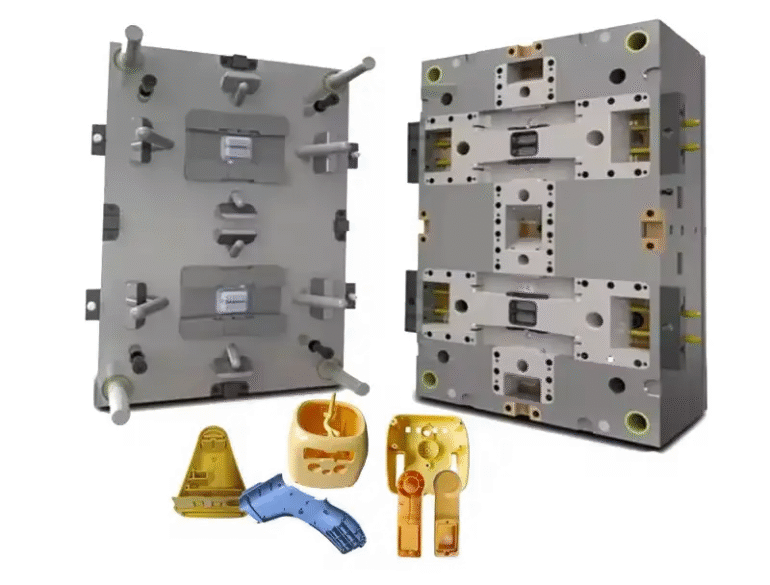
Cet article explique ce qu’est le moulage sur mesure, son fonctionnement, ses advantages, ses principales applications, ainsi que les technologies qui façonnent son avenir.
Qu’est-ce que le moulage sur mesure?
Le moulage sur mesure refers to the process of conception and fabrication of molds specifically adapted to the unique requirements of a product.
Au lieu d’utiliser des moules standardes, les manufacturers conçoivent un tool personnalisé corresponding perfectly to the geometry, au material et aux performances expectues du produit.
Le procédé comprend plusieurs étapes :
- Conception and engineering of the mold
- Selection of appropriate materials
- Fabrication of the tool with micrometric precision
- Tests et ajustements jusqu’à obtenir une pièce conforme aux tolérances requisées
The result: a production system capable of generating precise pieces, repeatable and adapted to complex forms , even on a large scale.
Les étapes du processus de molding sur mesure
Le moulage sur mesure combines ingénierie de conception, expertise en outillage et science des matériaux . Each phase directly influences the final quality and cost.

1. Conception and analysis of the product
The process begins with understanding the client’s product. The engineers examine the design, the dimensions, the mechanical and aesthetic requirements.
Thanks to 3D software (CAO), they model the piece and the mold cavity.
Durant cette phase, we evaluate notably:
- The thickness of the walls
- Les angles de dépouille pour le démoulage
- Le placement des points d’injection
- The conception of the cooling system
- The compatibility of materials
Des simulations d’écoulement de matière (mold flow) allow potential defects to be detected in advance: air bubbles, retraction or deformation.
2. Material selection
The choice of plastic is essential, because it determines the resistance, flexibility, appearance and cost of the product.
The current materials include:
- ABS (Acrylonitrile Butadiene Styrene) : robuste et résistante aux chocs
- Polypropylene (PP) : light and resistant to chemical products
- Polycarbonate (PC) : transparent and resistant to heat
- Nylon (PA) : durable and wear-resistant
- Acrylique (PMMA) : transparent and brilliant, ideal for optical pieces
For technical needs, engineering resins such as PBT, POM or PEI are also used.
3. Mold manufacturing
Once the conception is validated, the mold is made using CNC machines, electro-erosion (EDM) and precision rectification .
Fabriqué en acier ou en aluminum, il est poli, ajusté et assemblé avec soin, souvent avec des tolérances de quelques microns.
A mold consists of:
- Core and cavity define the shape of the piece
- Système d’alimentation – guide la matière fondue
- System d’éjection – permet le retrait de la pièce
- Cooling system – regulates the temperature and accelerates the cycle
Une fabrication soignée guarantees durability, precision and constant performance .
4. Testing and validation
Avant la production de masse, le moule subit des essais appelés sampons T1/T2 .
Les pièces test sont evaluated selon :
- Dimensions and tolerances
- The surface appearance
- Filling and cooling
- Structural performance
Les ajustements nécessaires sont effectues jusqu’à obtenir une pièce parfaite.
5. Mass production
Once validated, the mold is installed on an automated injection press . Each cycle produces one or more pieces according to the number of cavities.
The quality inspectors continuously check the dimensions, finish and traceability of the lots.
Les principaux types de molding sur mesure
- Moulage par injection sur mesure
La méthode la more voudée: la resine fondue est injected dans un moule fermé sous pression. Parfait pour les formes complexes et les grandes séries. - Moulage par compression
Utilisé pour le caoutchouc or les thermodurcissables. The heated material is compressed in the mold to form solid pieces. - Moulage par soufflage
Idéal pour les pièces creuses (bouteilles, conduits, reservoirs). L’air dilate le plastique chauffé contre les parois du moule. - Moulage rotatif
Méthode économique pour les grands produits creux comme les cuves ou conteneurs. Le moule en rotation ensures a uniform coating. - Overmolding and insert molding
Techniques combinant plusieurs matériaux ou integrant des inserts métalliques dans la pièce, améliorant résistance et functionality.
Les avantages du molding sur mesure
- Precision adapted
Each detail is designed according to the exact specifications of the client. - Liberté de conception
Complex forms, unique textures and multi-material integration become possible. - Profitability à grande échelle
The initial investment in the mold is compensated by a weak cost unitary in continuous production. - Qualité constante
Once the mold is optimized, each piece produced is identical, guaranteeing reliability and coherence. - Choice of materials varied
Hundreds of resins can be used to answer all mechanical or aesthetic requirements. - Reduction of waste
Modern systems optimize the flow of matter and energy, reducing losses.
Applications du molding sur mesure
- Automobile : interior panels, clips, connectors, tableau de bord components.
- Medical : sterile devices, diagnostic equipment, biocompatible pieces.
- Produits grand public : boîtes électroniques, utensils, accessoires domestiques.
- Emballage : bouchons, contenants et fermerthes résistantes et légers.
- Industriel et construction : carters, outillages personnalisés, components techniques.
In each sector, personalization guarantees compatibility, durability and performance .
Les défis du molding sur mesure
- Coût de l’outillage : élevé au départ mais rentable sur le long terme.
- Retrait du material : la contraction du plastique au cooling doit être anticipée.
- Optimization of the cycle : balance between cooling and ejection for fluid production.
- Défauts de surface : évités par une conception et un contrôle thermique précis.
- Maintenance : regular cleaning and inspection to prolong the life of the mould.
Les technologies qui révolutionnent le moulage moderne
- CAD/CAM integration – passage fluide de la conception au fraisage.
- Usinage CNC 5 axes – ultra precise mold geometries.
- Impression 3D – rapid prototyping and validation of designs.
- Optimization IA – simulation of flux and cooling.
- Robotisation – automatic manipulation of parts and cycle constants.
- Intelligent sensors (IoT) – real-time monitoring of pressures and temperatures.
These innovations reduce costs, accelerate production and improve precision.
Sustainability and eco-design
Custom molding contributes to industrial durability in :
- Reducing material losses
- Utilisant des polymers recyclables or biosourcés
- Intégrant des machines à faible consommation d’énergie
- Recyclant les carottes et canals d’injection
- Allégeant les pièces finales pour economizer ressources et énergie
De plus en plus d’usines adoptent des pratiques éco-responsables sans comprometre la qualité.
Choisir le bon partner en molding sur mesure
The essential criteria:
- Expérience confirmée en conception de moules
- Pointe equipment and integrated engineering
- Quality certifications (ISO, IATF, FDA)
- Support en prototypage et simulation
- Communication réactive et accompagnement technique
A competent partner is not limited to making pieces : it helps to optimize your conception and guarantee the success of each production.
L’avenir du moulage sur mesure
The future of this industry rests on:
- L’ IA appliquée à la conception
- Le moulage hybride et imprimé en 3D
- Les bioplastics écologiques
- The digital twins for real time monitoring
- Les micro-usines locales pour la production à la demande
Ces tendances rendront la fabrication plus rapide, plus verte et plus personnalisée .
Conclusion
Le moulage sur mesure relies on creativity and precision engineering .
By combining advanced design, high-performance materials and automation, it allows companies to produce reliable, aesthetic and profitable plastic components.
Des pièces automobiles aux dispositifs médicaux, cette technologie reste la clé de la fabrication moderne , façonnant les innovations de main.


